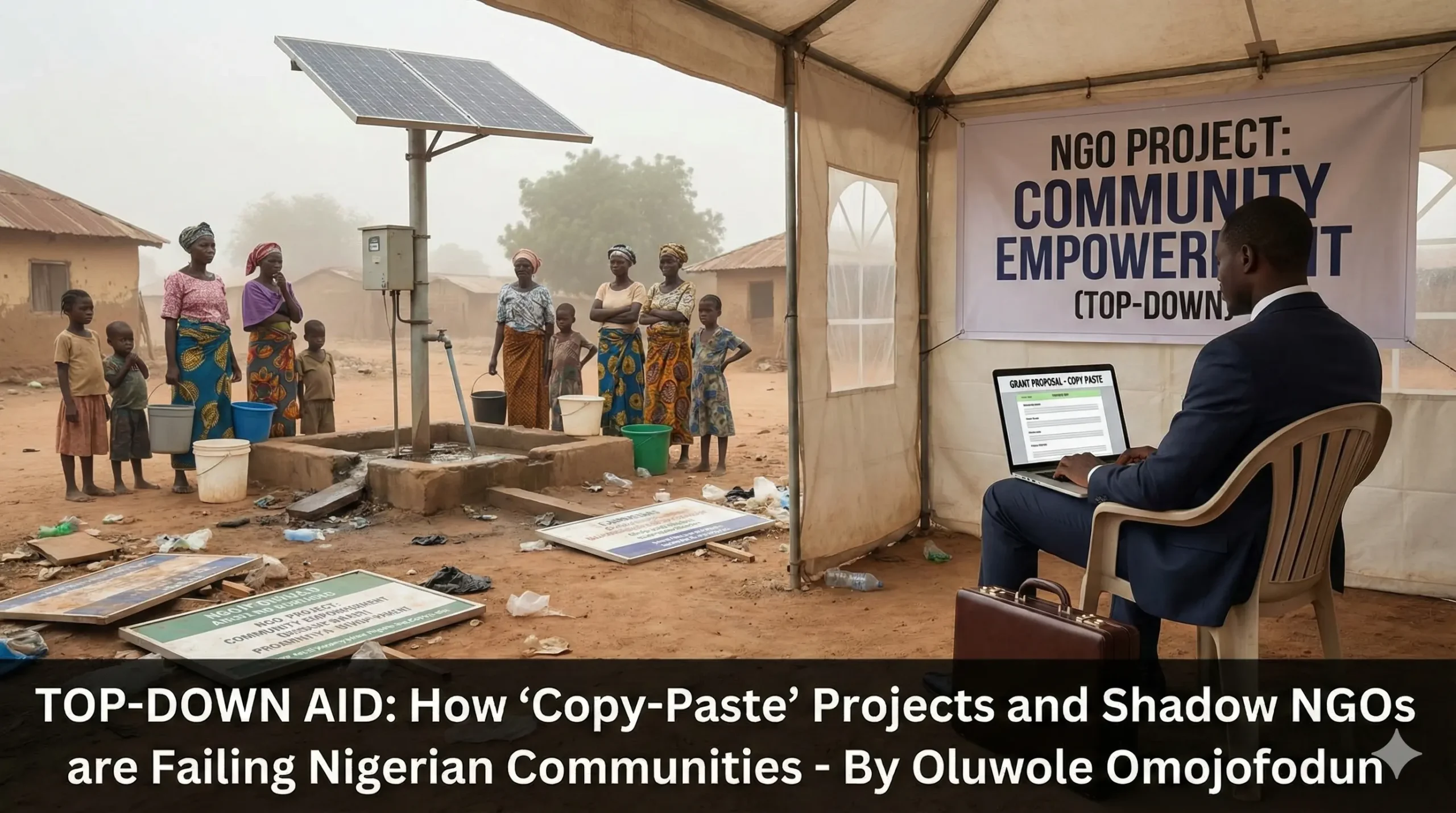
Billions of dollars in international development grants, alongside vast sums of federal and state constituency allocations, flow into Nigeria every decade. Yet, a brief journey through the rural and peri-urban landscapes of our country reveals a contradictory, stark reality: staggering deprivation, dilapidated infrastructure, and communities seemingly frozen in time. The Nigerian landscape is literally littered with the concrete carcasses of failed public infrastructure projects and abandoned development initiatives.
This severe disconnect between the monumental funds disbursed and the actual impact achieved on the ground is not merely a product of accidental mismanagement or bureaucratic inefficiency. It is the result of a deliberate, structural exploitation of the aid and development sector.
Through the lens of Following The Money, the investigative journalism arm of GrantsDatabase, we have been rigorously tracking these systemic anomalies. What we are consistently uncovering is a thriving ecosystem built on the illusion of impact. This investigation dissects the three primary culprits responsible for the stagnation of community development in Nigeria today: the unchecked proliferation of politically motivated ‘shadow’ or ‘briefcase’ NGOs, the epidemic of ‘copy-paste’ grant chasing by opportunistic grantpreneurs, and the inherent evil of top-down project implementation that alienates the very communities it claims to serve.
Part 1: The Shadow Economy of Briefcase NGOs
The term ‘NGO’ (Non-Governmental Organisation) traditionally evokes noble images of grassroots activists, humanitarian workers, and civil society watchdogs standing on the frontlines to hold the powerful to account. However, in Nigeria, a sinister parallel industry has emerged and flourished over the past decade. We are witnessing the normalisation of ‘briefcase NGOs’—shadow organisations that exist almost entirely on paper. These entities often manifest as a well-dressed individual clutching a briefcase full of letterheads and proposals, but possessing absolutely no programmatic footprint, staff, or community presence on the ground.
Independent research, including comprehensive reports tracking civil society legitimacy in West Africa, indicates that hundreds of these shadow organisations have been activated in recent years. Astoundingly, fewer than 7 per cent of these so-called civil society groups are legally registered with the Corporate Affairs Commission (CAC) under Part F of the Companies and Allied Matters Act (CAMA) 2020 as Incorporated Trustees. They do not file annual returns, they lack audited financial statements, and they utterly bypass compliance with the Special Control Unit Against Money Laundering (SCUML).
These shadow NGOs generally operate with two distinct, malicious motives. The first is political sycophancy. Many of these groups are tightly controlled by a small, overlapping network of political aides and masterminds. They act as attack dogs and praise-singers for the political elite, popping up overnight to hold identically staged press conferences in Abuja or Lagos to defend government officials from corruption allegations, or to discredit legitimate human rights organisations. Once the news cycle moves on, these organisations evaporate into the ether, possessing no physical address, no digital footprint, and no genuine board of trustees.
The second motive is financial conduitry. Briefcase NGOs are frequently utilised as vehicles for money laundering and the diversion of public funds. Because they lack basic internal compliance frameworks, they become the perfect, opaque vessels for receiving off-budget government funding, illicit patronage, or even misdirected international aid. They siphon critical resources that should have been channelled into authentic community development, leaving the most vulnerable populations in rural Nigeria to pay the ultimate price. This deeply skews the public narrative and discredits the genuine, hardworking NGO sector.
Part 2: The ‘Grantpreneur’ and the Copy-Paste Epidemic
While briefcase NGOs operate largely in the political and illicit financial shadows, another insidious problem plagues the seemingly legitimate development sector: the rise of the ‘grantpreneur’. As a professional grant writer with over five years of active experience in the field, I have navigated the rigorous demands of project conceptualisation and proposal development. Crafting a sustainable, impactful project requires deep local insight, meticulous planning, and genuine engagement. Yet, there is a rapidly growing faction within the sector that treats grant writing not as a tool for social problem-solving, but purely as a lucrative, cynical enterprise.
This mindset has birthed the ‘copy-paste’ epidemic. Instead of identifying a pressing local problem and subsequently seeking the funding to resolve it, grantpreneurs obsessively monitor the shifting priorities of international donors. If the global philanthropic trend shifts overnight from HIV/AIDS intervention to climate finance, or from education to artificial intelligence in agriculture, these opportunistic organisations immediately pivot. They do so regardless of their actual institutional capacity, their prior expertise, or the realities of their local operating environment.
To secure this funding, they resort to plagiarising project proposals. They scrape grant databases, copy abstracts and methodologies from successful interventions executed in Kenya, India, or South Africa, and simply paste them into their own templates, casually swapping out ‘Nairobi’ for ‘Kano’ or ‘Enugu’. The result is a profoundly disconnected document that brilliantly ticks all the donor’s buzzword boxes but completely lacks contextual relevance.
The devastating impact of this practice is twofold:
- The Sidelining of Indigenous Groups: It crowds out authentic, grassroots community-based organisations. These local groups may lack the slick, sophisticated proposal-writing vocabulary of the urban grantpreneurs, but they possess the actual community trust and competencies required to effect real change.
- The ‘Hotel Advocacy’ Phenomenon: Because the copy-paste project was never designed for the dirt-road realities of rural Nigeria, a disproportionate amount of the grant—often up to 80 per cent—is exhausted on administrative overheads, capacity-building workshops, glossy seminars, and lavish tea breaks in expensive metropolitan hotels. The funds are thoroughly depleted before a single tangible benefit reaches the target demographic. When the funding cycle inevitably ends, the project vanishes, leaving absolutely no sustainable infrastructure or improved livelihoods behind.
Part 3: The Evil of Top-Down Aid and Zero Co-Creation
Even in scenarios where an organisation is legally registered and the grant proposal is completely original, projects frequently and spectacularly fail due to a fundamental, philosophical flaw: the top-down approach. This is the saviour complex in full manifestation, where organisations design interventions for a community rather than co-creating with the community.
In the top-down model, critical developmental decisions are made in air-conditioned offices far removed from the geographical, economic, and socio-cultural realities of the intervention site. Project managers rely on abstract datasets and boardroom assumptions to determine what a community in the Niger Delta or the North East ostensibly needs. They fail to conduct rigorous, grassroots needs assessments or engage in meaningful dialogue with the community leaders, local women, and youth who will be the actual end-users of the proposed solution.
This blatant exclusion of the target audience from the problem-solving process is nothing short of development malpractice. It leads directly to catastrophic misallocations of resources. As accountability trackers, we routinely uncover newly constructed, highly expensive solar-powered boreholes situated in areas where the water table is entirely dry, rendering the multi-million-Naira infrastructure completely useless on the day of commissioning. We observe high-tech computers donated to rural primary schools that have neither electricity connections nor teachers trained to operate the devices. We see agricultural processing mills donated to farming communities that cultivate entirely different crops.
Historical data from public infrastructure audits reveals that there are thousands of failed or abandoned federal and state projects scattered across the country. A significant percentage of these failures can be traced back to poor conceptualisation and a total lack of community ownership.
When locals are not consulted during the planning phase, and when no local labour or expertise is utilised during the execution phase, the community feels absolutely no sense of responsibility toward the project. They do not know who holds the maintenance manuals, nor do they possess the technical knowledge or the mandate to repair the infrastructure when it inevitably breaks down. The project, designed without their input, ultimately dies without their intervention. The top-down approach distorts the role of the people, reducing them from creative forces and active stakeholders in their own development to mere passive recipients of charity. It strips them of their agency and almost guarantees the failure of the intervention.
Conclusion: Reclaiming Accountability Through Data and Transparency
The prevailing dynamics of shadow NGOs, copy-paste grant chasing, and top-down project implementation have severely compromised the integrity of civil society and community development in Nigeria. However, this grim reality is not irreversible. The antidote to this systemic failure lies in radical transparency, rigorous accountability, and an uncompromising return to bottom-up, community-led development models.
First, regulatory bodies such as the CAC, SCUML, and the Financial Reporting Council of Nigeria must aggressively enforce compliance. An organisation that cannot produce an audited financial statement, proof of legal registration, or evidence of genuine grassroots impact should not be permitted to masquerade as a representative of the people or siphon development funds.
Secondly, international donors and local grant-making institutions must radically overhaul their evaluation mechanisms. It is imperative to move beyond glossy proposals and sophisticated buzzwords. Due diligence must include verifying the historical footprint of the organisation and ensuring that the proposal demonstrates genuine, documented co-creation with the target community. Funding must be strictly directed toward organisations that prioritise the ‘why’ and the ‘who’ over the mere administrative mechanics of the ‘how’.
Finally, the transformative power of data cannot be overstated. We cannot fix what we cannot accurately see. This has been the driving philosophy behind GrantsDatabase since its launch on May 29, 2025, to bridge the critical information gap in the development sector. As we continue to advance tools like the Open Aid Tracker—an investigative journalism initiative I am currently pursuing through the Reynolds Journalism Institute Individual Fellowship—our ultimate goal is to democratise the monitoring of development funds.
By comprehensively tracking the flow of capital from the donor to the exact geographical coordinates of the project, we can empower local citizens to ask the crucial questions: Was this funded? Was it built? Does it actually work?
Community-led development is only effective when the locals are the active architects of their own change. It is time to dismantle the illusion of impact, expose the briefcase NGOs, and demand that every Naira and Dollar spent in the name of development actually serves the people it was destined for.