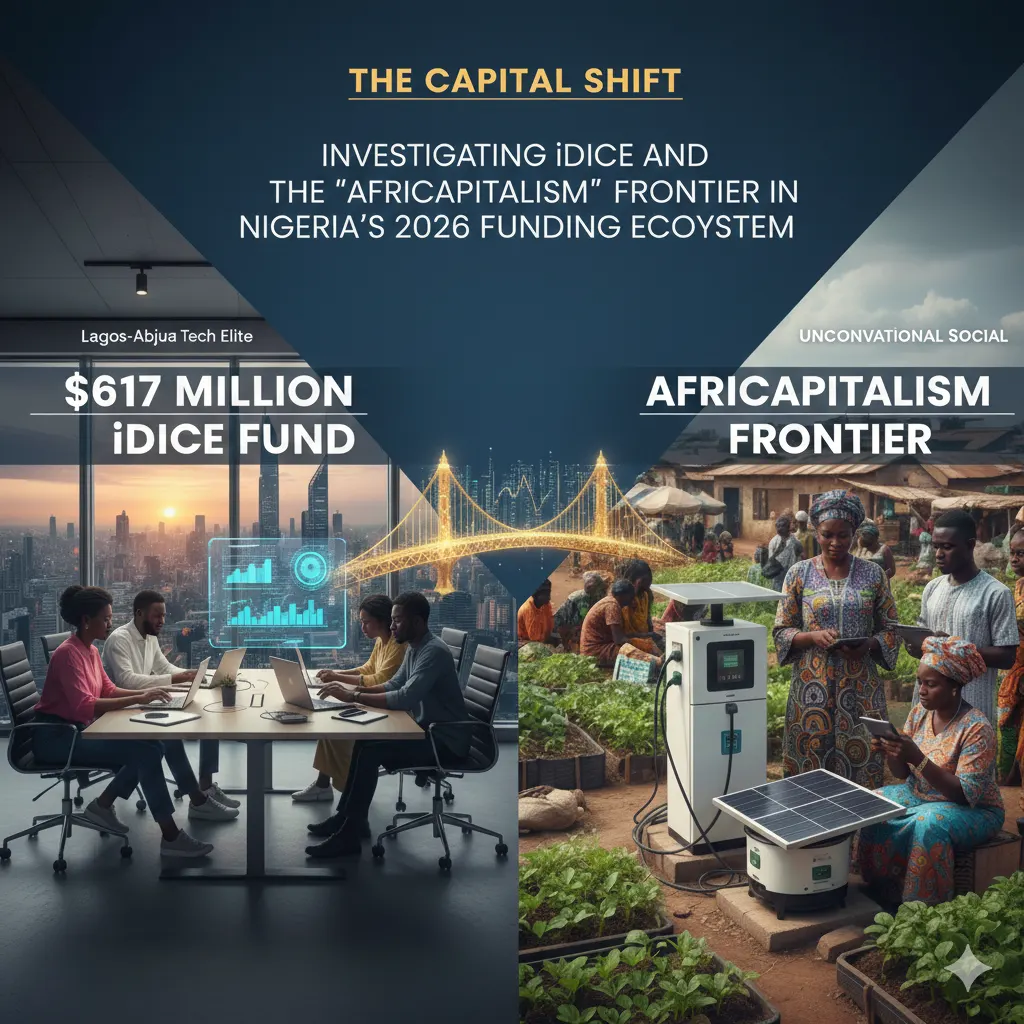
The Nigerian development landscape is currently undergoing its most significant structural transformation since the 1970s. As of January 2026, the era of “foreign aid dependency” is being aggressively replaced by Africapitalism, a philosophy championing private-sector-led development through long-term investment.
At the heart of this shift is the $617.7 million Investment in Digital and Creative Enterprises (iDICE) programme and the 2026 cycle of the Tony Elumelu Foundation (TEF). This investigation follows the money to determine if this capital is truly democratizing opportunity or merely reinforcing the dominance of the Lagos-Abuja “Tech Elite.”
1. The iDICE Blueprint: Tracking the $617M Disbursement
The iDICE programme is a multi-lateral powerhouse funded by the African Development Bank (AfDB – $170M), the French Development Agency (AFD – $116M), and the Islamic Development Bank (IsDB – $70M), with the Nigerian government and private sector providing the balance.
The “Fund of Funds” Strategy
In a move to move away from bureaucratic grant-making, iDICE has adopted a “Fund of Funds” model. Rather than the government picking winners, they are investing in professional Fund Managers:
- The Technology Fund: In August 2025, Ventures Platform was appointed as the lead Fund Manager. By November 2025, they achieved a $64 million first-round close, targeting a final $75 million by Q1 2026.
- The Creative Sector Fund (New for 2026): Launched this month, this fund is specifically carved out for film, fashion, and music startups that traditionally lack “hard assets” for bank loans.
- The Indirect Fund: This “Fund of Funds” is designed to invest in smaller, regional micro-VCs across Nigeria to reach entrepreneurs outside the main hubs.5
Source: State House Abuja: FG to Launch Two New Additional Investment Funds for Nigerian Startups (Nov 2025)
2. Africapitalism in Action: The Tony Elumelu Foundation (TEF) 2026
While iDICE focuses on high-growth scaling, the Tony Elumelu Foundation remains the “Entry Point” for grassroots social entrepreneurs. On January 1, 2026, TEF opened its 12th cycle, offering:
- $5,000 Non-refundable Seed Capital: Acting as a “de-risking” mechanism for early-stage ideas.
- The 2026 “BeGreen Africa” Initiative: A specialized 2026 focus on climate-resilient entrepreneurship, ensuring that green startups receive priority funding.
TEF reports that as of early 2026, they have funded over 24,000 entrepreneurs across Africa, with a significant 46% female participation rate, the highest in the foundation’s history.
Source: Tony Elumelu Foundation Opens 2026 Entrepreneurship Programme (Jan 2026)
3. The “Elite Capture” Audit: Who is Actually Benefiting?
The central tension of our investigation is the Geographic and Social Concentration of these funds.
The “Lagos-Abuja Corridor” Dominance
Historical data from the iDICE pilot phases suggests a heavy tilt:
- 90% of Tech Unicorns: All five of Nigeria’s unicorns (including the recently minted Moniepoint) are headquartered in Lagos.
- Fund Manager Proximity: Ventures Platform, the primary iDICE technology manager, is based in Lagos, which naturally creates a “proximity bias” for startups in the Yaba and Victoria Island ecosystems.
The Counter-Trend: Reaching “Unconventional” Entrepreneurs
To combat this, the 2026 iDICE framework has introduced Regional Capacity Building Centers.
- Skills Component: iDICE is targeting 175,000 young Nigerians for digital skills training in non-metropolitan areas (e.g., Gombe, Kano, and Ebonyi).9
- State-Level Nodes: The Bank of Industry (BoI), the executing agency, has decentralized applications to its 30 state offices to ensure rural social entrepreneurs can bypass the “Abuja gatekeepers.”
4. Investigative Findings: From “Aid” to “Equity”
Our analysis shows that the shift to investment-led growth has changed the type of beneficiary:
- The Decline of the “Grant-Writer”: Nonprofits that survived on donor grants are now being forced to restructure as “Social Enterprises.” If they cannot show a revenue model, iDICE and TEF are increasingly passing them over.
- The Rise of the “Impact Startup”: 2026 has seen a surge in “Agri-tech” and “Ed-tech” startups in Northern Nigeria, funded by iDICE’s Islamic Development Bank (IsDB) portion, which mandates Sharia-compliant, ethical investment models.
| Fund Component | 2026 Status | Primary Target |
| iDICE Tech Fund | $64M Raised | High-growth AI & Fintech |
| Creative Sector Fund | Application Open | Nollywood, Fashion, Music |
| TEF Seed Capital | Deadline: March 1 | Grassroots/Idea-stage startups |
| iDICE Skills Hub | Rollout Phase | 175,000 trainees nationwide |
5. Conclusion: The Verdict
Is the money reaching “unconventional” entrepreneurs? Partially. While the top-tier equity (the $617M iDICE fund) is still heavily concentrated in the hands of the Lagos tech elite and sophisticated fund managers like Ventures Platform, the secondary components (Skills development and TEF seed grants) are successfully penetrating the rural “unconventional” market.
The move from “Aid to Investment” is successfully creating a more sustainable ecosystem, but there is an urgent risk that those who are not “digitally literate” by the end of 2026 will be permanently excluded from the Nigerian economic miracle.