


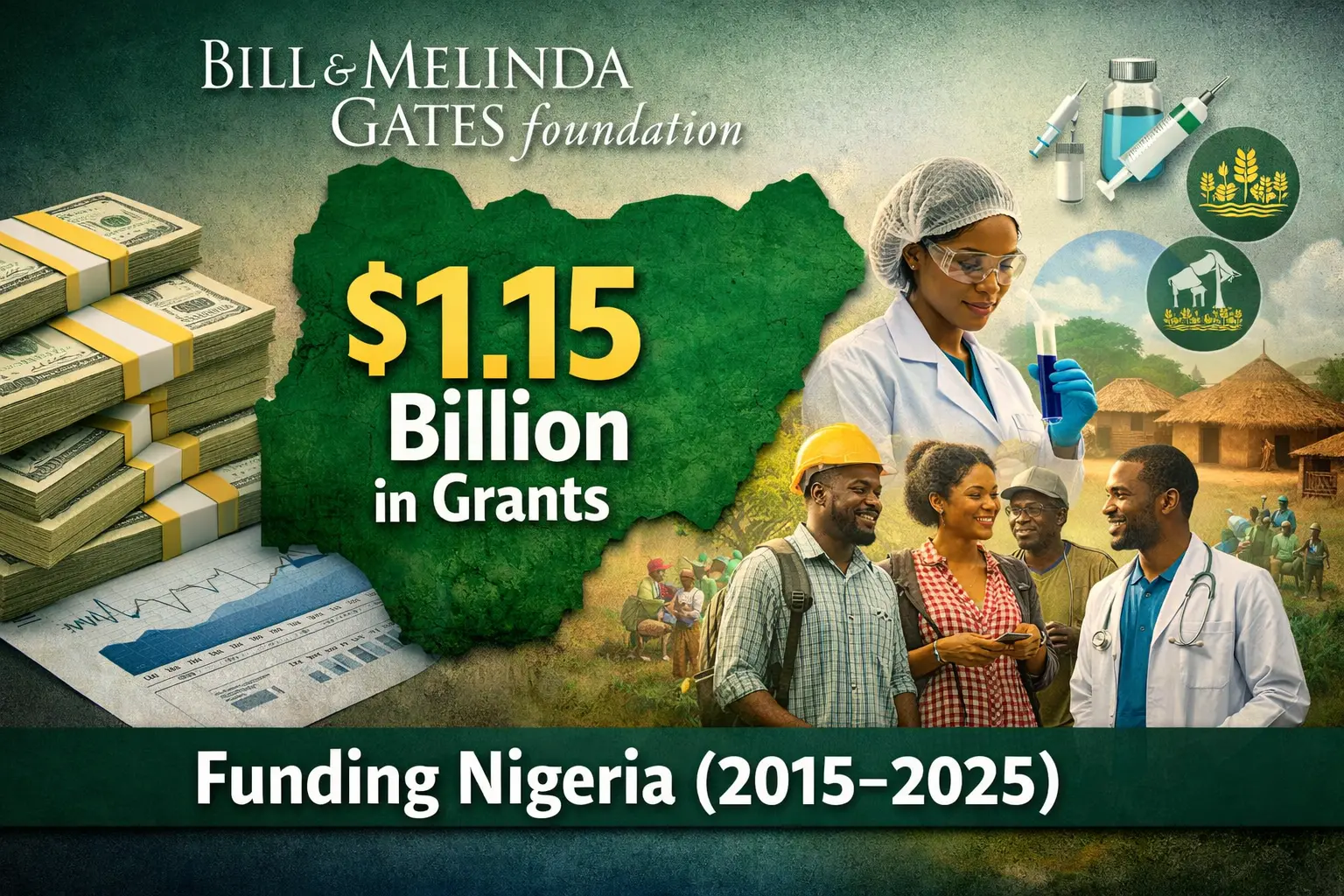
Nigeria sits at the centre of Africa’s biggest development questions: how to reduce preventable maternal and child deaths, strengthen primary healthcare, improve immunisation coverage, boost agricultural productivity, expand financial inclusion, and ensure women and girls have the tools and autonomy to thrive. These are not abstract policy debates. They play out in clinics, farms, laboratories, state ministries, and communities every day.
One funder appears again and again across these systems: the Bill & Melinda Gates Foundation (now commonly referenced as the Gates Foundation). The Foundation’s footprint is widely discussed, but the public conversation often lacks a clean, evidence-based answer to a simple question:
How much has the Gates Foundation committed in grants to Nigeria, and who exactly receives it?
This “Following the Money” investigation answers that question using the Foundation’s own Committed Grants Database and downloadable dataset. The tone here is impact-first: the aim is to show the scale and shape of Gates-funded work in Nigeria, and the ecosystem it supports, while also noting a few transparency realities that matter when interpreting the data.
Methodology (what we counted, what we did not)
Primary dataset
This analysis uses the Gates Foundation’s Committed Grants Database and the Foundation’s downloadable CSV of committed grants (updated 3 March 2026).
The Foundation is explicit about a key limitation: the database includes grants only and does not include direct charitable contracts or program-related investments (PRIs). That matters because it means this investigation captures a major part of giving, but not necessarily every dollar the Foundation spends in or for Nigeria.
Time window
We filtered the grants dataset to include entries where:
- Grantee Country = Nigeria, and
- Date committed falls between January 2015 and December 2025 (inclusive).
Important interpretation note: “committed” is not “disbursed”
“Amount committed” represents a grant commitment (often multi-year). It is not the same thing as cash paid out in that same calendar year. The database is best used to understand funding intent and allocation patterns, not annual cash flow in Nigeria’s economy.
What this analysis does not fully capture (but we highlight)
Many Nigeria-impact grants are awarded to non-Nigeria grantees (for example, a UK-based organisation implementing programming in Northern Nigeria). Those grants matter to Nigeria, but they do not appear when filtering by “Grantee Country = Nigeria”. An example is a Gates grant to BBC Media Action that explicitly targets Northern Nigeria, even though the grantee is located in the United Kingdom.
Because of this, our totals should be read as:
“Committed grants to Nigeria-based recipients” (money landing in Nigerian institutions),
not “all Gates funding that benefits Nigeria”.
The headline number: Nigeria-based recipients received about $1.156 billion in committed grants (2015–2025)
Across 2015–2025, the Gates Foundation committed approximately:
USD 1,155,788,894
to organisations and recipients with Grantee Country = Nigeria (as recorded in the Foundation’s committed grants dataset).
This is a very large figure by any standard of private philanthropy.
It also aligns directionally with an OECD analysis of philanthropic flows to Nigeria. In that OECD report, international philanthropic flows to Nigeria are estimated at USD 1,154 million, with 93% attributed to the Gates Foundation. The OECD figure is not identical to our “Nigeria grantee country” filter (it uses a broader philanthropic-flow approach), but it provides external validation that Gates-linked philanthropy constitutes a dominant share of international philanthropic funding to Nigeria in the measured period.
Table 1: Year-by-year commitments to Nigeria-based grantees (2015-2025)
These are commitments recorded in the Gates dataset for Nigeria-based recipients.
| Year | Amount committed (USD) |
|---|---|
| 2015 | 79,235,674 |
| 2016 | 62,211,400 |
| 2017 | 161,031,470 |
| 2018 | 30,691,259 |
| 2019 | 89,081,284 |
| 2020 | 49,943,390 |
| 2021 | 61,504,088 |
| 2022 | 148,584,295 |
| 2023 | 113,946,805 |
| 2024 | 216,728,854 |
| 2025 | 142,830,375 |
What the pattern suggests: the Gates Foundation’s Nigeria commitments are not a smooth, predictable line; they spike in certain years. That typically reflects the nature of philanthropy at scale: large multi-year commitments (especially in health systems, immunisation, and agricultural programmes) can cause annual totals to swing.
Who receives Gates grants in Nigeria?
A persistent myth in public debate is that big philanthropy flows mainly to “NGOs.” The Nigeria picture is more varied.
Using the grantee names in the dataset, we classified recipients into broad categories (for example: government agencies, universities/research institutions, NGOs/nonprofits, private sector). This is a best-effort approach based on naming signals and known institution types; it should be read as a practical map of the ecosystem, not a legal classification.
Table 2: Recipient type breakdown (Nigeria-based grantees, 2015-2025)
| Recipient type | Total committed (USD) | Share |
|---|---|---|
| University / research / hospital | 386,691,128 | 33.5% |
| Multilateral / international organisation (Nigeria offices) | 204,888,181 | 17.7% |
| NGO / nonprofit | 159,997,102 | 13.8% |
| Government / public agency | 148,388,866 | 12.8% |
| Private sector / for-profit | 143,162,493 | 12.4% |
| Individual / fellow | 73,619,264 | 6.4% |
| Other / unclear | 39,041,860 | 3.4% |
Key insight: The largest single share in this dataset goes to universities, research institutes, and hospitals (about one-third). That makes sense given Nigeria’s role in global health research, vaccine delivery learning, agricultural research, and monitoring/evaluation infrastructure.
Just as important: government and public agencies together represent a major channel (nearly 13% in this classification). That aligns with the Gates Foundation’s stated approach in Nigeria: working with government and partners to improve health outcomes, boost agricultural productivity, expand digital financial services, and empower women and marginalised populations.
Table 3: The top Nigeria-based recipients (by committed amount, 2015-2025)
Below are the largest Nigeria-based recipients in the dataset over the period (rounded to nearest dollar).
| Rank | Grantee (Nigeria-based) | Amount committed (USD) |
|---|---|---|
| 1 | World Health Organization Nigeria Country Office | 194,799,242 |
| 2 | International Institute of Tropical Agriculture (IITA) | 154,431,038 |
| 3 | Solina Center for International Development and Research | 90,174,496 |
| 4 | Federal Ministry of Health, Abuja | 66,371,175 |
| 5 | Technical Advice Connect LTD/GTE | 49,957,178 |
| 6 | Health Strategy & Delivery Foundation | 32,486,103 |
| 7 | Society for Family Health | 25,785,215 |
| 8 | Pan-Atlantic University Foundation | 23,556,130 |
| 9 | Sahel Consulting Agriculture & Nutrition Limited | 22,979,139 |
| 10 | College of Medicine of the University of Lagos | 22,370,830 |
Two things stand out:
- Health systems and immunisation architecture are strongly represented, including major health institutions and the WHO Nigeria Country Office. This mirrors broader global analysis showing how large Gates contributions to WHO have historically concentrated around infectious diseases and vaccine-linked priorities (a global context, not Nigeria-specific).
- Agriculture and food systems appear prominently through institutions such as IITA and agriculture/nutrition-focused consultancies and implementers. That is consistent with the OECD report’s observation that, after health, agriculture is a major beneficiary sector of international philanthropy in Nigeria.
What are the grants for? A “topic” view of Gates commitments to Nigeria-based recipients
The Gates dataset includes a “Topic” field, and Nigeria’s topic distribution tells a clear story: health dominates, particularly vaccine-preventable disease work and immunisation ecosystem support, with agriculture as a major second pillar.
Table 4: Top grant topics by committed amount (Nigeria-based grantees, 2015-2025)
| Topic (as recorded in dataset) | Amount committed (USD) |
|---|---|
| Polio | 248,332,508 |
| Agricultural Development | 195,497,510 |
| Global Health and Development Public Awareness and Analysis | 171,391,443 |
| Maternal, Newborn, Child Nutrition and Health | 71,539,597 |
| Vaccine Delivery | 25,649,473 |
| Inclusive Financial Systems | 18,557,454 |
| Empower Women and Girls | 18,698,194 |
A few observations help interpret this:
- “Polio” at the top is not a surprise. Nigeria’s polio programme history has been one of the most closely watched global health efforts of the last two decades, and Nigeria’s systems have provided lessons that influenced global vaccine delivery practice.
- “Public Awareness and Analysis” appears as a major line item. In practice, this often includes data, analytics, policy work, strategic communications, and implementation learning, elements that do not always look like direct service delivery but can strengthen systems and improve programme effectiveness.
- Maternal and child nutrition and health remains a major pillar, consistent with Nigeria’s continuing challenges around maternal outcomes, child survival, and nutrition.
- Financial inclusion and women and girls’ empowerment appear in the Nigeria-based grants picture, but they are smaller than the largest health and agriculture categories, at least under the “grantee country = Nigeria” filter.
Geography inside Nigeria: where Nigeria-based grantees are located
Where the grantee is headquartered matters because it often signals where institutional capacity is concentrated, where decision-making happens, and where ecosystem networks are thickest.
Table 5: Top grantee locations by committed amount (Nigeria-based recipients, 2015-2025)
| Location (grantee city/state) | Amount committed (USD) |
|---|---|
| Abuja / FCT | 644,087,642 |
| Oyo (notably Ibadan) | 166,542,826 |
| Lagos | 154,838,616 |
| Kano | 34,789,184 |
| Borno (notably Maiduguri) | 11,933,139 |
| Kaduna | 10,617,632 |
What this suggests: Nigeria’s Gates-linked institutional receiving points are heavily concentrated in Abuja, Ibadan, and Lagos, which is consistent with how national and international development ecosystems are structured in Nigeria:
- Abuja hosts federal institutions, national agencies, and country offices for multilaterals and large implementers.
- Ibadan is home to major agricultural and research capacity (including IITA and other scientific infrastructure).
- Lagos is home to large NGOs, private sector partners, universities, and key convening networks.
This does not mean the impact is confined to those places. It means the recipient institutions are concentrated there. Delivery can still occur nationally, especially when grants fund nationwide immunisation systems, surveillance, agricultural extension, or multi-state programming.
Spotlight: why this pattern can be a strength for Nigeria’s development ecosystem
A fair assessment of this funding flow should recognise what it enables at its best:
1) Systems strengthening, not only projects
A large share of grantmaking goes to organisations that shape systems: ministries and agencies, international health architecture, and research institutions. Systems investments can be less visible than “building a facility,” but they are often what makes service delivery work repeatedly, across many years.
2) Institutional capacity in Nigerian science and implementation
The strong share for universities and research institutions signals more than academic activity. It suggests an ecosystem where Nigeria-based institutions are playing roles in implementation research, data systems, programme evaluation, and solution testing, work that can produce long-term national capacity.
3) Agriculture is not treated as a side issue
Nigeria’s food systems are central to livelihoods and resilience. Seeing agricultural development as one of the top topics reinforces the importance of productivity and nutrition together, rather than viewing agriculture as separate from health outcomes. This is aligned with Nigeria’s broader development needs, and with the OECD’s sector observations about Nigeria philanthropic flows.
Light accountability: three interpretation cautions Nigerians should know
This is an impact-first investigation, but credibility requires clear cautions.
Caution 1: Nigeria “benefit” is larger than Nigeria “grantee country”
Many Nigeria-targeted projects are implemented by grantees based outside Nigeria. If you only look at “Nigeria-based recipients,” you undercount Nigeria-impact funding.
The BBC Media Action example illustrates this clearly: the grant purpose explicitly targets Northern Nigeria, but the grantee location is in the UK.
What to do in future investigations: create a second lens that filters by “Nigeria” in purpose text and “region served,” not just by grantee country. That requires careful text analysis and avoids false precision.
Caution 2: Committed does not mean disbursed immediately
Some grants are multi-year and may be paid out over time. The annual totals show commitment timing, not necessarily annual cash flows.
Caution 3: This is not the whole of development finance
Gates grants are one component of Nigeria’s broader financing landscape. Nigeria also receives ODA, multilateral financing, and domestic spending. For national accountability, Nigeria’s Development Cooperation Dashboard offers a place to view and export assistance activities recorded by donor, though coverage depends on reporting and system completeness.
What this means for Nigerian NGOs, researchers, and public institutions
A few practical implications emerge from the data:
- Research and technical institutions are major recipients. Nigerian universities, research centres, and hospitals are not peripheral; they are core funding channels. For researchers, this reinforces the value of building credible partnerships, ethical research capacity, and strong dissemination pipelines.
- Government-facing work matters. Significant commitments reach federal institutions and agencies in the dataset. For Nigerian NGOs and implementers, programmes that align with national systems (rather than bypassing them) appear to have a stronger fit with large-scale philanthropic approaches.
- Health and agriculture remain the biggest lanes. Organisations building work around immunisation systems, infectious disease control, maternal/child health, nutrition, and agricultural development will likely find more alignment with historical giving patterns than those in less represented areas, at least in the Nigeria-based recipient lens.
Closing: the size of the flow is clear, now Nigeria can ask smarter questions
From 2015 to 2025, the Gates Foundation committed about $1.156 billion in grants to Nigeria-based recipients, a level of philanthropic financing that has materially shaped parts of Nigeria’s health and agriculture ecosystem.
The story is not simply “money to NGOs.” It is a more complex and, in many ways, more encouraging picture: strong support for research and institutions, meaningful engagement with government and system architecture, and continued prioritisation of health and agriculture as the pillars of population wellbeing and economic resilience.
