


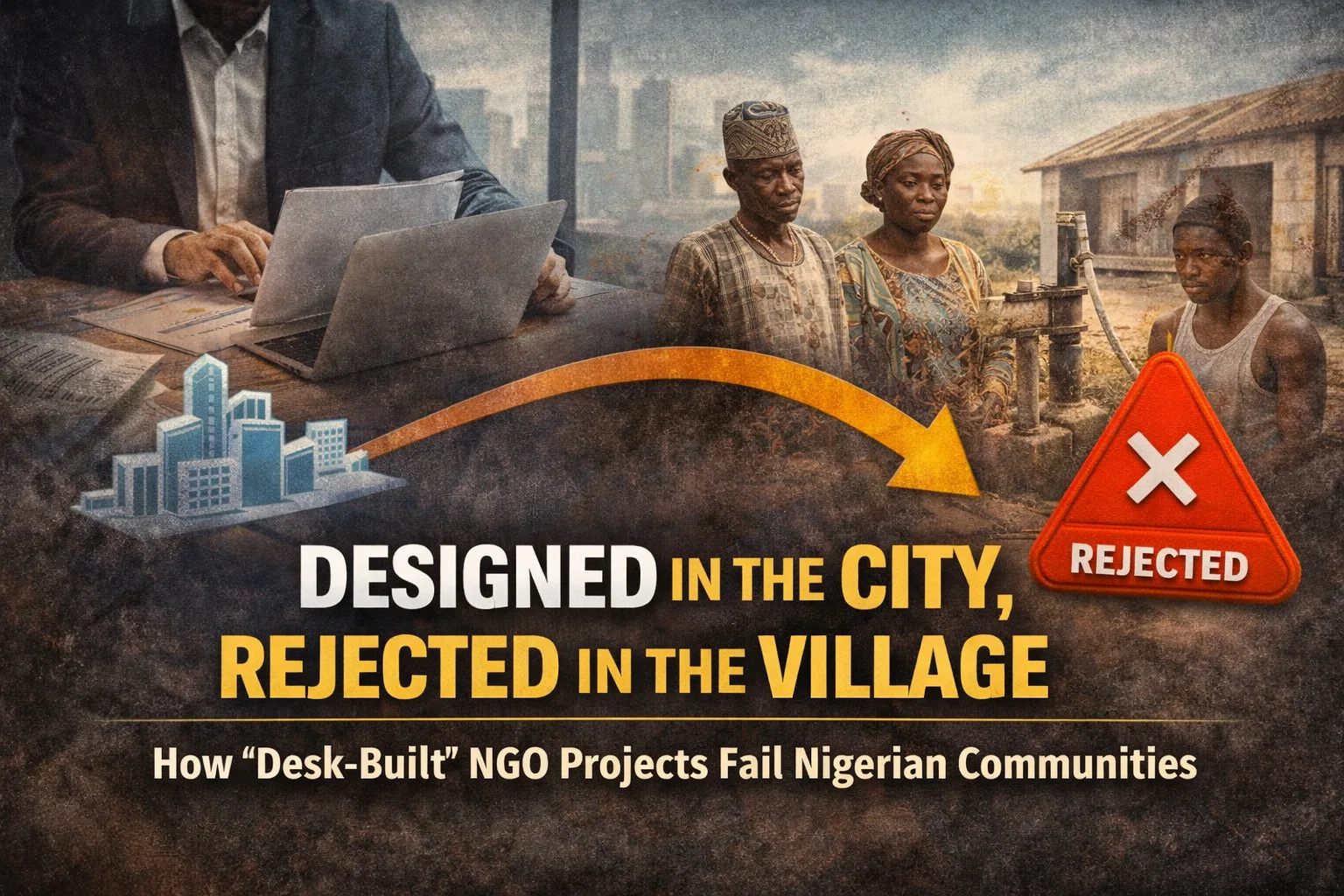
A community gets a brand-new water point, skills centre, clinic block, or “empowerment” scheme. Photos are taken. A report is written. Then the project quietly stops working, is locked up “for safety,” or is simply ignored because it solves the wrong problem in the wrong way. Months later, it becomes another monument to wasted money and broken trust.
Across Nigeria, a recurring pattern sits behind many rejected or abandoned interventions: projects designed far from the community, without meaningful consultation, then dropped into local realities they do not understand. This investigation examines that pattern, why it happens, what it costs, and what the strongest evidence says about sustainability when communities are not involved in project design.
We use publicly available reports, evaluations, and documented cases to build the accountability trail and propose a practical standard Nigerian NGOs and donors can adopt immediately.
1) What “desk-built” really means (and how it shows up)
A “desk-built” project is not simply a project designed in a city. It is a project whose core decisions (problem definition, intervention choice, location, design, delivery modality, and “success metrics”) are made without meaningful community participation.
In practice, desk-built design has recognizable symptoms:
- No needs assessment in the community (or a “needs assessment” based on secondary sources only).
- Community engagement reduced to one-way sensitisation after the project is already planned.
- Selection of “beneficiaries” via gatekeepers, lists, or political patronage, rather than community-validated criteria.
- Implementation focused on delivery of assets (boreholes, classrooms, ICT equipment) with weak maintenance, ownership, or grievance mechanisms.
- Monitoring that measures outputs (number trained, number items delivered) but not sustained use or functionality months later.
This is not a theoretical claim. The sustainability evidence in Nigeria repeatedly points to the same failure mechanism: weak ownership leads to weak maintenance, low uptake, and eventual abandonment.
2) The sustainability evidence: why “no community voice” becomes “no project life”
The WASH mirror: when “delivery” is not “service”
Water projects are one of the most visible arenas where desk-built design becomes measurable failure. UNICEF’s sustainability analysis of Nigeria’s WASH sector cites a stark indicator: only 77% of publicly used water points are functional at any given time, based on the 2021 WASH National Outcome Routine Mapping (WASHNORM). The same report notes very low scores for operation and maintenance (11%) and for system design and configuration (14%), two areas strongly shaped by whether communities are involved in design and ownership.
The implication is not merely technical. A water point fails faster when it is installed without:
- a locally agreed maintenance plan,
- a management committee,
- clarity on tariffs or contributions (where appropriate),
- and community buy-in on location and access rules.
The institutional acknowledgement: community participation affects sustainability
A World Bank programme document for Nigeria’s water supply and sanitation “Program-for-Results” explicitly states that limited community participation and transparency significantly impact the sustainability of WASH programmes and projects.
This is important because it shifts the debate from opinion to institutional evidence: sustainability is not only about engineering; it is also about social legitimacy and governance.
3) “Following the money”: desk-built projects are often output-rich and service-poor
When a project is designed without community input, the money tends to flow into line items that are easy to execute and easy to report, while the “difficult” work of participation is underfunded.
A practical way to see this is to look for what projects spend on:
- consultancy and technical assistance,
- workshops and trainings,
- per diems and meetings,
- branding and media,
- and procurement of visible assets,
compared to what they spend on:
- participatory assessments,
- local facilitation,
- community governance structures,
- grievance/feedback channels,
- and post-implementation support for operations and maintenance.
This pattern is not limited to NGOs; it is visible across Nigeria’s broader public project ecosystem, and it matters because NGOs often operate inside the same incentives and funding architecture.
Tracka’s tracking numbers show how projects slip into “not started,” “abandoned,” or “unknown”
BudgIT’s Tracka project tracking report provides a hard accountability lens. Between January 2020 and June 2021, Tracka reports tracking 1,439 Zonal Intervention Projects, of which 288 were “not started,” 21 were “abandoned,” and 357 had “unspecified locations.” It also reports tracking 1,826 Federal Consolidated Projects, of which 335 were “not started,” 112 were “abandoned,” and 417 had “unspecified locations.”
Even though these are government-linked project categories, the takeaway applies to NGO work: when projects do not have clear location accountability, verified community ownership, and ground-truth monitoring, they drift into the same failure states: unfinished, abandoned, or untraceable.
4) What rejection looks like on the ground: from “misfit” to “resistance”
Communities reject desk-built projects in at least five ways:
- Silent rejection: low turnout, low uptake, no one uses the asset.
- Active resistance: complaints, protests, refusal to participate.
- Elite capture: local power brokers hijack benefits; community members disengage.
- Security response: assets are locked up “for protection,” which becomes non-use.
- Vandalism or abandonment: when no one feels ownership, no one protects it.
Desk-built projects often miss local constraints that only community conversations reveal: social norms, land disputes, power structures, seasonal livelihoods, migration patterns, insecurity, and practical realities of maintenance.
5) A documented Nigerian case: when “development money” becomes abandoned infrastructure
A powerful illustration of how projects can fail communities is an investigation by The International Centre for Investigative Reporting (ICIR) on Itsekiri communities, reporting abandoned projects and alleged mismanagement related to a large community development fund.
The point for this investigation is not to generalise one case to all. It is to show how quickly communities lose trust when the gap between “announced development” and “usable services” becomes normal. NGOs operating in the same environments face the same trust deficit: once communities have seen repeated abandonment, they become skeptical of new interventions, especially those that arrive fully designed.
6) Why NGOs build projects without communities (the uncomfortable incentives)
From the reporting patterns across Nigeria’s development ecosystem, five incentives repeatedly drive desk-built design:
A. Deadline pressure and proposal competition
Many funding calls reward speed and polished documentation. When deadlines are tight, community engagement becomes optional, especially if travel is costly or security is a concern. A logframe gets written first; consultation gets “added later.”
B. Donor template bias
Some funding architectures are built around pre-defined outputs (number trained, number assets delivered). That pushes implementers to prioritise measurable delivery over co-creation.
C. “Consultant gravity”
Proposal writing is often consultant-led. Consultants may not have time, budget, or mandate for deep community immersion, so they rely on assumptions and generic “needs statements.”
D. Urban concentration of NGO operations
Many NGOs are headquartered in cities, with field presence limited to short implementation visits. Without local partners or community structures, real engagement becomes difficult.
E. Security and access constraints
In conflict-affected or high-risk areas, remote design becomes tempting. But remote design without trusted local engagement partners often produces the worst mismatch.
None of these incentives are excuses. They are explanations and understanding them is the first step to reforming them.
7) What works better: evidence from community-driven development
Nigeria has evidence that community-driven approaches can improve relevance and ownership. The World Bank’s Completion and Results report on Nigeria’s Community and Social Development Project (CSDP) describes it as “demand-driven” and notes that CDD programmes aim to improve living conditions through increased participation.
The key lesson is simple: when communities have a role in identifying priorities, planning micro-projects, and monitoring implementation, projects are more likely to match local needs and be maintained.
This does not mean community-driven design is perfect, elite capture and delays can still occur but it is a tested correction to the desk-built failure pattern.
8) The “Desk-Built Risk Index”: a practical tool for investigators (and donors)
To make this investigation actionable, below is a simple diagnostic you can use to assess whether a project was likely desk-built.
Table 1: Desk-Built Risk Index (DBRI)
| Indicator | What to look for | Risk if missing |
|---|---|---|
| Pre-design consultations | Evidence of community meetings before the proposal was final | High mismatch risk |
| Participatory needs assessment | Community problem ranking, not only desk research | Wrong problem, wrong solution |
| Community validation | Signed minutes, public commitments, transparent criteria | Low ownership |
| Local implementation partners | Credible local CSO/CBO or community structures | Weak trust and access |
| Grievance/feedback mechanism | Phone line, focal persons, complaint logs | Unaddressed resentment |
| O&M / sustainability plan | Committee, spare parts plan, tariffs/roles | Asset failure |
| Post-implementation support | Follow-up visits, coaching, maintenance training | Early breakdown |
A project does not need to score perfectly. But when several of these are missing, rejection becomes predictable, not surprising.
9) What the sustainability numbers are really telling us
Put the evidence side by side:
- 77% functional public water points at any given time (meaning a large share are not functioning).
- Extremely low emphasis on operation and maintenance and system design quality signals in national sustainability checks.
- World Bank documentation explicitly linking limited community participation to sustainability challenges.
- Large pools of projects tracked with “not started,” “abandoned,” or “unspecified locations.”
These are not isolated facts. Together they describe a system where:
- delivery is rewarded,
- participation is underfunded, and
- maintenance is an afterthought—
so communities end up with assets, not services.
That is the heart of desk-built failure.
10) The fix: “Minimum Viable Participation” (MVP) as a standard
If Nigeria’s NGO sector wants to reduce rejection and improve sustainability, it does not need more slogans. It needs minimum standards.
Table 2: Minimum Viable Participation (what every community project should prove)
| Stage | Minimum requirement | Evidence you can publish |
|---|---|---|
| Before design | At least two consultations with diverse groups (women, youth, marginalised) | Meeting minutes, attendance lists (aggregated), priority ranking |
| Design | Co-designed intervention options + community selection | Signed validation note; agreed site plan |
| Implementation | Community role in monitoring and grievance | Named committee; complaint log process |
| Handover | Maintenance plan + responsibilities + financing model | O&M guide, committee roster, spare parts plan |
| After delivery | Follow-up checks at 3 and 12 months | Functionality report; user satisfaction data |
This standard is compatible with what sustainability-oriented institutions already emphasise: community participation is not decorative; it is functional.
Conclusion: “No footprints, no future”
Desk-built projects fail for reasons Nigeria already understands: they are disconnected from lived reality. They arrive with assumptions instead of conversations. They deliver assets instead of services. They exit without ownership, leaving communities to manage systems they never asked for and cannot maintain.
The evidence is not subtle. National WASH sustainability findings show functionality gaps and weak operations and maintenance. Major programme documents acknowledge that limited community participation undermines sustainability. And Nigeria’s broader project environment shows how quickly projects become abandoned or untraceable without ground accountability.
If Nigerian NGOs and donors want projects that are accepted, used, and sustained, they must treat community participation as a core deliverable, not a ceremonial step after decisions are made.
Because in development, the harsh truth is this:
When communities are not part of the design, they will not carry the project. And what they do not carry will not last.
