


For the past decade, the MacArthur Foundation’s “On Nigeria” programme has served as the tectonic plate upon which Nigeria’s anti-corruption ecosystem rested. This was not merely a grant cycle; it was a “Big Bet”—a philanthropic strategy that injects massive, concentrated capital into a single issue to force systemic change. The figure on the ledger is staggering: $154.1 million (₦230 billion+ at current rates) invested between 2015 and the programme’s official sunset in December 2024.
As of February 2026, the silence left by this exit is deafening. For ten years, this funding built the servers that host BudgIT’s fiscal data, paid the legal retainers for investigative journalists facing state harassment, and fuelled the logistics for Follow The Money teams trekking to rural primary healthcare centres.
Now, the “Big Bet” has concluded. While the Foundation remains active in other global spheres, the dedicated “On Nigeria” tap has run dry. This investigation audits the fallout of this exit, analysing the final 2024/2025 filings to determine which organisations were granted a “golden parachute” to ensure their survival, and which have been left to face the harsh fiscal winter of 2026 alone.
I. The ‘Tiered Exit’ Strategy: A Tale of Two Civil Societies
Our forensic analysis of the final tranche of grants disbursed in late 2024 reveals that the MacArthur Foundation did not execute a uniform withdrawal. Instead, they employed a “Tiered Exit” strategy, creating a stark division between organisations transitioned to long-term sustainability and those given a final, modest handshake.
1. The Anchors: Secured Through 2026 and Beyond
These organisations received substantial, multi-year extensions just before the programme closed, effectively insulating them from the current funding crisis.
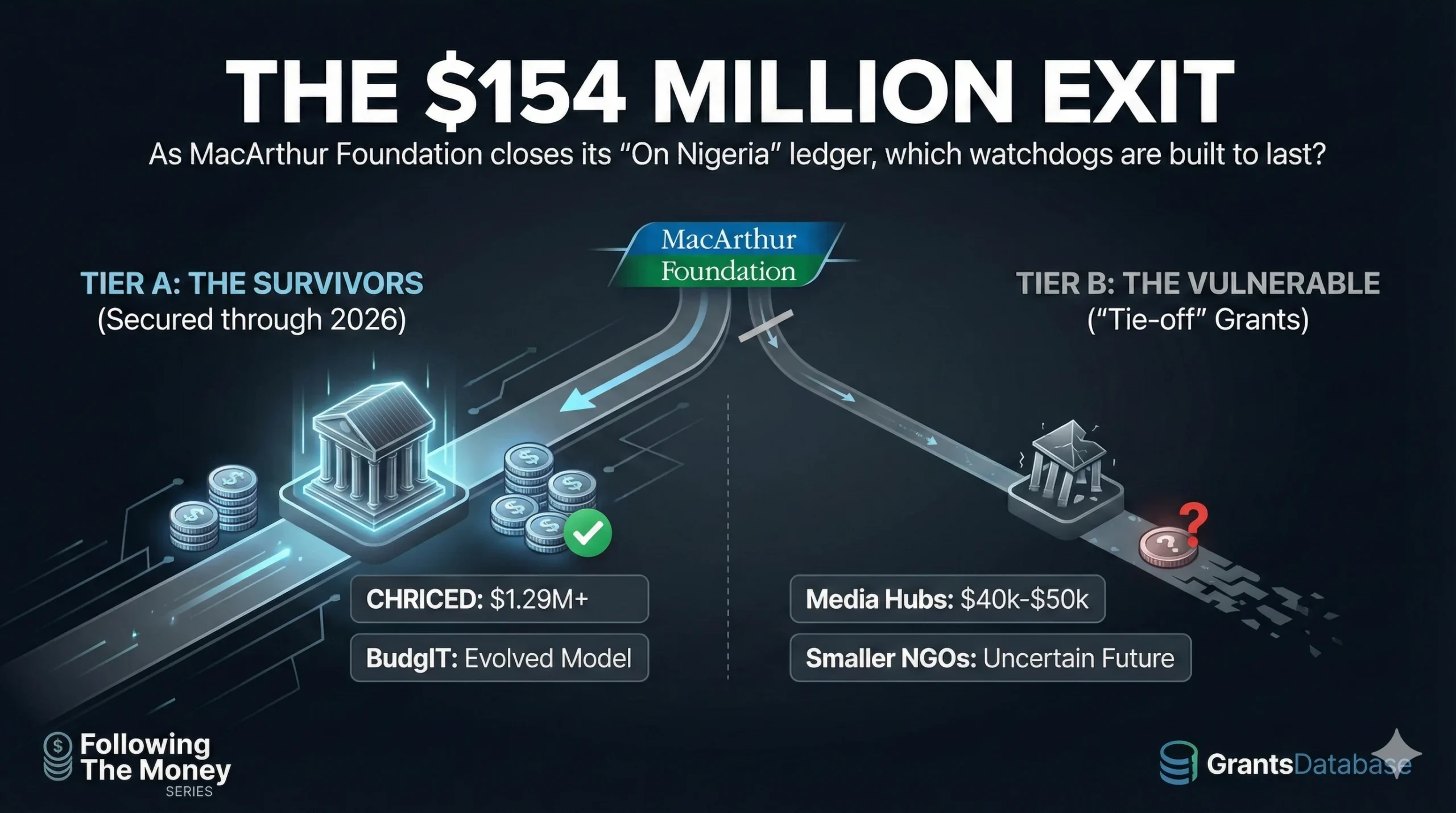
- The Survivor: CHRICED (Resource Centre for Human Rights & Civic Education) In a landscape defined by cuts, CHRICED stands as a notable anomaly. Our analysis of the final ledger shows they secured a massive $1.29 million grant in 2024, with a tenure running through to mid-2026.
- The Strategy: Why CHRICED? Unlike generalist anti-corruption bodies, CHRICED pivoted to represent the “Original Inhabitants” of the Federal Capital Territory (FCT). By linking corruption to the specific, tangible grievances of a marginalised indigenous group, they made themselves indispensable. They are no longer just fighting “corruption” in the abstract; they are fighting for land and cultural rights, a nuance that secured their survival.
- The Pivot: BudgIT Foundation BudgIT represents the “Gold Standard” of the MacArthur exit strategy. Their final allocation—$480,000 (2023–2025)—was explicitly earmarked for “Organisational Resilience.”
- The Evolution: BudgIT has effectively graduated from “grantee” to “sector consultant.” They no longer rely solely on donor goodwill; they have monetised their data expertise, offering technical support to the very state governments they monitor. While this ensures financial survival, it raises a complex ethical question for 2026: Can a watchdog bite the hand that pays its consultancy fees?
2. The Legacy Network: The $50,000 Goodbyes
The majority of the “On Nigeria” cohort received what the sector calls “Tie-off Grants”—one-time disbursements ranging from $35,000 to $50,000 in 2024.
- Connected Development (CODE) / Follow The Money: Receiving a final $40,000–$50,000 tie-off, CODE faces a critical test. Their model relies heavily on logistics—sending personnel to remote locations to track constituency projects. Without the flexible MacArthur funds, which often covered operational overheads that other donors refuse to pay, CODE must now rely on stricter, project-tied funding from European donors, potentially limiting their ability to react spontaneously to corruption scandals.
- Wole Soyinka Centre for Investigative Journalism (WSCIJ): The Centre received $50,000 for sustainability. This is a precipitous drop for the hub that managed the multi-million dollar “CMEDIA” project. The risk here is existential for the broader media landscape: WSCIJ acted as a re-granter, funnelling MacArthur cash to smaller newsrooms. With the hub’s funding reduced to a trickle, the downstream effect is that dozens of small, independent investigative desks across Nigeria are now technically insolvent.
II. The ‘Joinbodi’ Experiment: Forced Marriage or Genuine Alliance?
A central pillar of the MacArthur legacy was the “Joinbodi” (Solidarity) Cohort. The thesis was simple: if you force NGOs to collaborate for five years, they will form a permanent alliance that renders individual fundraising obsolete.
- The 2026 Verdict: The results are mixed.
- The Failure: With the central coordinator (MacArthur) no longer present to mediate disputes and fund joint secretariats, the “Joinbodi” network is fraying. The harsh reality of 2026 is that competition for the remaining funding pools (such as the Ford Foundation or Luminate Group) is pitting these former allies against one another. The collaborative spirit is struggling against the survival instinct.
- The Success: The Administration of Criminal Justice (ACJ) monitoring remains a bright spot. Because this cohort successfully embedded their work into state laws and court procedures, the mechanism survives without cash. The collaboration between the police, the judiciary, and civil society has been institutionalised—a rare victory where policy reform has outlived the grant cycle.
III. The Behavioural Turn: From Handcuffs to Hearts
Perhaps the most subtle shift in the final years of the “On Nigeria” programme was the realisation that “naming and shaming” was insufficient. Arrests were rare, and convictions even rarer.
Consequently, the final legacy grants heavily favoured Behavioural Change initiatives. Organisations like the Lux Terra Leadership Foundation, which works with religious leaders to preach anti-corruption messages from the pulpit, received sustained support. The logic is that if the legal system is gridlocked, the moral system must take over. In 2026, we are seeing a shift in the “market” for anti-corruption work: less forensic accounting, and more town halls, radio dramas, and religious sermons.
V. The 2026 Vacuum: The Rise of the ‘Consultancy Trap’
With $154 million removed from the ecosystem, two concerning trends are emerging in the 2026 fiscal landscape:
- The Consultancy Trap: To survive the funding winter, watchdogs like Dataphyte and BudgIT are increasingly undertaking contract work for government agencies (e.g., building data portals for State Governments). While this “GovTech” model keeps the lights on, it creates a potential conflict of interest. The sector is moving from adversarial advocacy to collaborative technical assistance. The question remains: Is the watchdog still watching, or is it now working for the house?
- The Death of Long-Form Investigations: Investigative journalism is the most expensive and least profitable form of media. It requires months of work, legal risks, and travel costs. The “CMEDIA” project subsidised this for years. Without it, we forecast a sharp decline in deep-dive reporting in Q3/Q4 2026. Media houses will likely revert to “churning” daily press releases to drive clicks and ad revenue, as they can no longer afford the luxury of a six-month investigation.
Conclusion: The End of an Era
The MacArthur Foundation’s exit is not an abandonment; it is a graduation. The Foundation successfully built a robust infrastructure of data, laws, and platforms that did not exist in 2015. However, the “On Nigeria” era masked the fragility of the sector’s business model.
The organisations “Built to Last”—specifically CHRICED and BudgIT—are those that either found a niche so specific it commanded attention (Indigenous rights) or evolved a business model that sells value rather than begging for it (Data consultancy). For the rest, 2026 will be a year of painful restructuring, mergers, or silence.
