


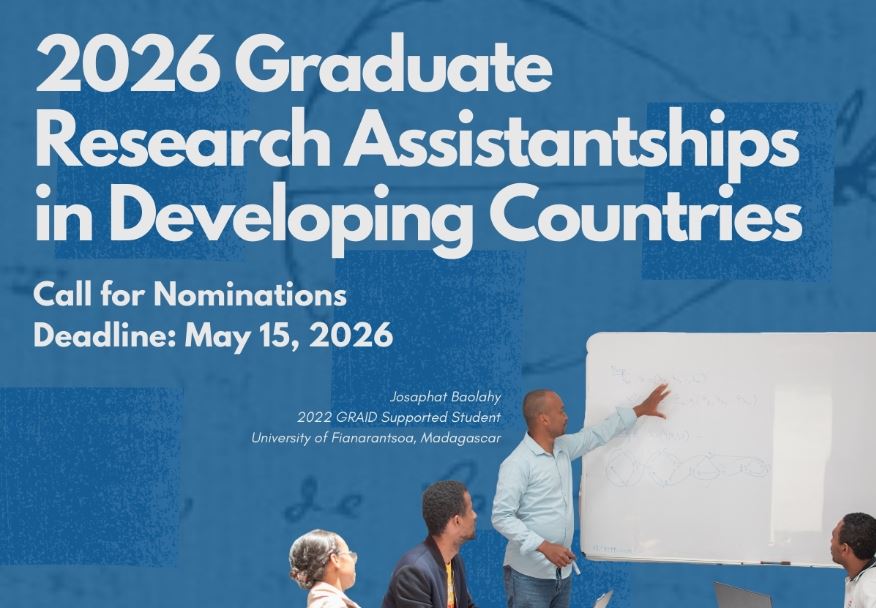
Deadline: May 15, 2026
The Graduate Research Assistantships in Developing Countries (GRAID) Program is a funding initiative designed to support talented graduate students in mathematics from developing countries. The programme provides financial assistance to help students pursue Master’s or PhD degrees in mathematics while working as research assistants within emerging research groups.
Established to strengthen mathematical research capacity in developing nations, the Graduate Research Assistantships in Developing Countries (GRAID) Program offers funding that allows students to focus on advanced studies and research without the burden of financial hardship. By supporting promising researchers and strengthening collaborations between mathematicians in developing and developed countries, the programme contributes to the global advancement of mathematical sciences.
This article provides a detailed overview of the programme, including eligibility requirements, funding benefits, application procedures, required documents, and reporting obligations.
Overview of the Graduate Research Assistantships in Developing Countries (GRAID) Program
The Graduate Research Assistantships in Developing Countries (GRAID) Program was launched in 2017 by the International Mathematical Union (IMU) through its Commission for Developing Countries (CDC). The programme was created to support emerging mathematics research groups in developing countries by providing funding for graduate students to serve as research assistants.
The central goal of the programme is to strengthen research capacity in mathematics across developing countries. Many talented students in these regions face financial barriers that make it difficult to pursue full-time postgraduate studies. Through the GRAID programme, these students receive funding that allows them to focus on their studies while contributing to the research activities of their academic groups.
The programme also aims to promote international collaboration between researchers in developing countries and established mathematicians from more advanced research environments. Such collaborations help improve research quality, encourage knowledge transfer, and strengthen academic networks across borders.
Funding for the programme is supported through voluntary donations from mathematicians, universities, and mathematical institutions worldwide that are committed to advancing mathematical research in developing regions.
Objectives of the Programme
The Graduate Research Assistantships in Developing Countries (GRAID) Program has several key objectives:
Strengthening Mathematics Research Communities
The programme aims to help build strong and sustainable mathematics research groups in developing countries by supporting graduate students who can contribute meaningfully to ongoing research projects.
Supporting Talented Graduate Students
Through financial support, the programme enables academically strong students to pursue Master’s or PhD studies in mathematics without facing severe financial constraints.
Encouraging International Collaboration
Another important objective is to encourage collaboration between researchers in developing countries and international partners from more advanced research environments. These partnerships enhance research quality and expand academic opportunities for graduate students.
Building Long-Term Research Capacity
By funding graduate students and strengthening research groups, the programme contributes to the long-term development of mathematical sciences in developing countries.
Application Deadline
Applicants interested in the Graduate Research Assistantships in Developing Countries (GRAID) Program must submit their applications before the official deadline.
Application Deadline:
15 May 2026 (23:59 CET)
Applicants are encouraged to begin preparing their documents well in advance to ensure that all requirements are completed before the closing date.
Funding Benefits
The programme provides financial assistance to support graduate students working as research assistants in mathematics research groups.
Annual Funding Amount
Each assistantship provides up to $3,500 USD per year.
Number of Graduate Students Supported
A research group may request funding for up to two graduate research assistants.
If two students are selected within the same research group, the total funding amount of $3,500 will be shared between them.
Use of the Funding
The funding provided through the GRAID programme is designed to support essential academic and living expenses for graduate students. The stipend may be used to cover:
- Tuition fees
- Accommodation expenses
- Basic living costs
This financial support allows students to focus on their academic studies and research responsibilities.
Duration of Support
The duration of funding depends on the level of the student’s academic programme.
For PhD Students
Funding may be provided for up to four years, provided that the student continues to make satisfactory academic and research progress.
For Master’s Students
Funding may be provided for up to two years, or until the student completes the Master’s programme.
Renewal of Funding
Continued support each year depends on the student’s academic performance and the submission of satisfactory progress reports by the supervising research group.
Eligibility Criteria
To apply for the Graduate Research Assistantships in Developing Countries (GRAID) Program, specific eligibility requirements must be met by both the principal investigator and the nominated students.
Eligibility Requirements for the Principal Investigator
Applications must be submitted by a Principal Investigator (PI) who meets the following conditions:
- Must be a university professor in mathematics with a PhD degree.
- Must be affiliated with a university or research centre located in a developing country listed under Priority 1 or Priority 2 according to the programme’s classification.
- Must be actively supervising graduate students in mathematics.
- Must lead or be part of an emerging mathematics research group.
- Must maintain an ongoing collaboration with an international research partner located outside Priority 1 or Priority 2 countries.
The principal investigator is responsible for managing the research collaboration and supervising the nominated graduate students.
Eligibility Requirements for Students
Students nominated for the assistantship must meet the following criteria:
- They must have an excellent academic background in mathematical sciences.
- They must already be admitted into a Master’s or PhD programme in mathematics at the institution of the principal investigator.
- They must demonstrate strong potential for contributing to research within the group.
Students who are enrolled in joint graduate programmes with institutions located outside eligible developing countries are not eligible for the assistantship.
Role of the International Research Partner
An essential component of the Graduate Research Assistantships in Developing Countries (GRAID) Program is the collaboration with an international research partner.
The international partner should:
- Be an established mathematician based at a university or research institution outside Priority 1 or Priority 2 countries.
- Provide mentorship and research collaboration support.
- Participate in the development of the research proposal.
- Offer academic guidance that enhances the quality of the research programme.
This international collaboration strengthens the research capacity of the local group and provides graduate students with exposure to global research standards.
Required Application Documents
All application materials must be submitted in English and compiled into PDF documents.
Applicants are required to submit the following documents:
1. Collaboration Proposal (Maximum 3 Pages)
This document should describe the research collaboration between the principal investigator and the international partner. It should include:
- Research objectives
- Proposed activities
- Expected outcomes
- Role of the graduate research assistants
2. Curriculum Vitae of the Principal Investigator (Maximum 2 Pages)
The CV should summarise the PI’s academic background, research experience, publications, and supervisory experience.
3. Statement from the International Partner (Maximum 2 Pages)
The international partner must provide a written statement describing their role in the collaboration and their commitment to supporting the research project.
4. Curriculum Vitae of the International Partner (Maximum 2 Pages)
The CV should highlight the partner’s academic achievements, research expertise, and relevant publications.
5. Details of Nominated Graduate Students
Applicants must provide key information about the students being nominated for the assistantship.
6. Curriculum Vitae of Each Student
Each nominated student must submit a CV highlighting their academic achievements and research interests.
7. Academic Transcripts
Official transcripts must be provided to demonstrate the student’s academic performance in previous studies.
Application Process
The application for the Graduate Research Assistantships in Developing Countries (GRAID) Program is submitted by the principal investigator on behalf of the research group.
The application process generally involves the following steps:
- Identify qualified graduate students within the research group.
- Establish or confirm collaboration with an international research partner.
- Prepare the collaboration proposal outlining the research activities.
- Compile all required documents from the principal investigator, international partner, and nominated students.
- Submit the complete application before the official deadline.
Applicants should ensure that all documentation is complete and accurately prepared to avoid delays or rejection.
Evaluation and Selection
Applications are evaluated by the programme’s review committee based on several factors, including:
- The quality and feasibility of the proposed research collaboration
- The academic qualifications of the principal investigator
- The strength of the international partnership
- The academic achievements and potential of the nominated students
- The overall contribution of the project to mathematics research in developing countries
The programme prioritises projects that demonstrate strong collaboration, clear research goals, and significant potential to strengthen local research capacity.
Annual Reporting Requirements
Successful applicants must submit annual reports to maintain funding support.
Both the Principal Investigator and the International Partner are required to provide reports describing the progress of the research activities.
The reports should include:
- A summary of research progress
- Future research plans
- Publications resulting from the collaboration
- Academic progress of the graduate students
- Coursework and research milestones completed by the students
These reports help ensure that the programme’s objectives are being achieved and that the funded students are making satisfactory academic progress.
Impact of the Programme
Since its launch, the Graduate Research Assistantships in Developing Countries (GRAID) Program has supported numerous graduate students in mathematics across developing countries.
By providing financial assistance and encouraging international collaboration, the programme contributes to the development of strong research communities. Graduate students benefit from mentorship, improved research opportunities, and exposure to global academic networks.
Over time, such initiatives help build a new generation of mathematicians who can contribute to solving complex scientific and societal challenges.
Why the GRAID Programme Matters
Mathematics plays a critical role in solving real-world challenges across fields such as science, technology, engineering, economics, and public health. However, many developing countries face limited resources for advanced mathematical research.
The Graduate Research Assistantships in Developing Countries (GRAID) Program helps bridge this gap by providing targeted support to graduate students and research groups. By strengthening local research capacity and fostering international collaboration, the programme contributes to a more inclusive and globally connected mathematical research community.
Final Thoughts
The Graduate Research Assistantships in Developing Countries (GRAID) Program represents an important opportunity for mathematics research groups in developing countries to strengthen their research capacity while supporting talented graduate students.
Through financial assistance, mentorship, and international collaboration, the programme creates a supportive environment where students can pursue advanced studies and contribute to meaningful research in mathematics.
Research groups interested in applying should carefully review the eligibility requirements, prepare strong collaboration proposals, and ensure that all necessary documentation is submitted before the deadline.
Contact us for proposal drafting, refining, and review.
