


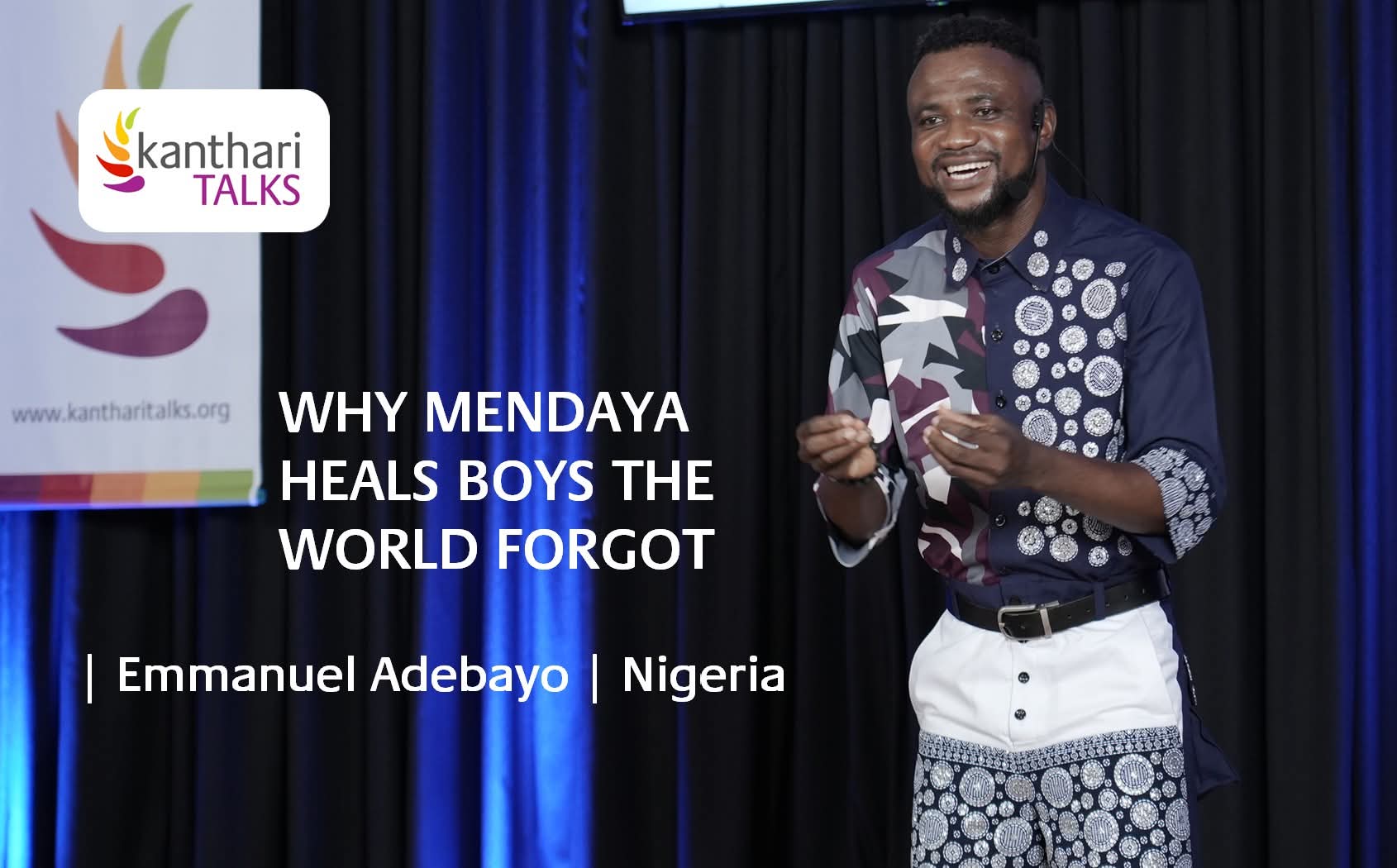
In this interview, Emmanuel Adebayo, Founder of MENDAYA and GrantsDatabase Young Changemaker of the Month (January 2026), reflects on his journey from survival to leadership, the role of creativity in healing, and his mission to create safe, empowering spaces for vulnerable boys. Through honest and thoughtful responses, Emmanuel shares the values, vision, and lived experiences shaping MENDAYA’s work and impact.
QUE: How do you describe who you are today, beyond your work and titles?
EMMANUEL: Today, I am an advocate for the rights of all children, especially boy-child advocates. A boy is a human being, and every right due a human being is the right of all children, including a boy. Beyond advocacy, I an social visionary working at the intersection of creative art, education and environment.
QUE: You’ve spoken about growing up without safe spaces to express fear or emotion. How did that experience shape the person you became?
EMMANUEL: For many years, I lived with a deep sense of worthlessness and an inferiority complex, not having confidence in myself, always wanting to prove my worth. I figured out later that all these feelings are traced to my childhood experiences and the series of abuse I went through. The experience somehow pushes me to look deep into myself and find my authenticity. And when I became a creative fashion designer, everything changed. I began to see myself differently. Fashion became a process and a tool for me to express myself safely without the fear of being judged, without prejudices. Everything I have become today is from that creative awareness.
QUE: Fashion became a turning point in your life. What did creativity give you when nothing else could?
EMMANUEL: Creativity gave me the freedom to dream, to imagine beyond by Inner world, to express my inner voice in whatever form. It gave me what I called creative rebellion and confidence. I became curious about everything, questioning everything I saw. That turning point was a force for me to create my own experiences independently of external interference. Creativity gave me independence of choice and options as an architect of my own outcome.
QUE: What moment made you realise that your personal journey could become something bigger — something that could help others?
EMMANUEL: Three or four years ago, I met three street boys with a creative way of begging on the street. They had made a mock teller machine from discarded material, which they use every day to beg on the street. I was captivated by this approach. And after I engaged them in a conversation, there was something about them; they had a dream, they were different. But there is something else invisible about them, their history of abandonment and neglect. They were carrying pain and burdens no one talked about or questioned. A boy who is not in school made a teller machine. This moment changes everything. My encounter with the boys reminded me of my own childhood. Personally, I heard a mindset shift from sympathy to admiration of their dream in the heart of every boy who feels neglected. This was when I decided to act.
QUE: Why did you choose to focus MENDAYA’s work specifically on vulnerable boys?
EMMANUEL: For many years, the world’s attention has always been on women and the girl child, and women. Justifiably so, and must continue. But what happens in a society where women are being empowered to make informed and independent choices, while men are left to figure it out? The question is this: do men, too, need empowerment? If yes, what time of empowerment do men need? At what point does a boy become a man? So, boys are often raised to be strong, but in many households, cultures, and societies, strength doesn’t include being soft or showing vulnerability. Boys who fall are told to get up. Boys who cry are told to stop acting like girls. Boys who feel too much are told to man up and be strong. But what happens when a boy learns to survive pain rather than process it? In their most developmental stage, boys go through a lot of issues that we often don’t look at. Who talks to boys about puberty? Who talks to boys about sex and their bodies? Who talks to boys about Hygiene? Just like that, a boy is expected to just figure things out, to just become a man. We don’t grow biologically into manhood; we are mentopred into manhood. And that is what is missing. Think about this: why are there more males in prison than females? Why are there more boys in juvenile homes? Why are there more males in drugs than females? Why are boys/men always named perpetrators of violence against women? Why is the suicide rate 75 per cent higher in men? When we empower women and leave men behind, we will create a society where men can no longer manage the women society is trying to empower. We at Mendaya imagined a different path, where boys grow seeing vulnerability and strength and as part of their humanity. If we do this, boys will grow into men who protect, not harm. Men who build, not break.
QUE: How does MENDAYA use creativity and fashion to help boys heal, build confidence, and make safer life choices?
EMMANUEL: Creativity is pure and resident in our childhood. At Mendaya, we create platforms where children, especially boys, express their creativity. Through visual art, they learn to express what they could not express with words to express. Paint and brush become their tool of expression. Through creative fashion design, they learn to design and make their own clothes, shoes, bags and whatever they dare to imagine using textile waste that is often discarded. Through high-energy sports like cycling, skating and football, they gain leadership skills and release stress from their body. We see creativity as a tool for healing, building confidence and gaining practical skills for safer life choices. By designing items for other vulnerable children, our participants learn empathy, overcome aggression and develop a sense of personal social responsibility.
QUE: What changes do you see in boys after they’ve spent time in a safe, expressive environment like MENDAYA?
EMMANUEL: We want to see boys who rise above their everyday issues. We want to see boys asking for help when needed the most. We want to see boys expressing their dreams, their creativity in whatever form they choose. We want to see boys developing positive coping mechanisms. We want to see boys who leading grassroot development, identify a need or problem in their community and channel their energy into designing solutions that impact their community. Imagine this: a boy who is often label ma problem child or neglected, now bringing projects that benefit everyone in the community. We want to see boys standing up for justice and the rights of all children, including girls. We want to see boys engaging peacefully with the opposite sex and leading the change in reducing gender based violence.
QUE: You challenge harmful ideas about masculinity. What does healthy masculinity look like to you?
EMMANUEL: Healthy masculinity allows a boy or a man to express his humanity without being ashamed or being judged. To see that being vulnerable enough to cry, to seek help, to speak out is not weakness but strength. It is not so much about the macho strength, aggression, self-sufficiency, dominance, emotional repression, but about respect and empathy, leadership, emotional intelligence, ethical responsibility, competence, self-awareness and healthy relationships.
QUE: What has been the most difficult part of building MENDAYA, and what keeps you going when things are hard?
EMMANUEL: It’s hard sometimes to say this is the most difficult part. But if I were to say that will be getting the right people. A work such as this requires some level of creative rebellion, and what do you do when you have people who want to play safe, or who want to protect culture? Have you heard about “this is how we do it in my culture”? This cultural programming leaves many people culturally unintelligent. Another hard part is who is funding. When you look at many funding organisations, especially around gender equality and feminism, it is always women and women-led organisations that are prioritised. So, sometimes it makes it difficult to find the right donor. What keeps me going is my sense of mission, sense of urgency, and sense of thoroughness. The idea that, even when things are not going well, this remains my purpose. This one thing I do, ensuring that every vulnerable child, especially boy,s gets the safe space to learn, dream, create and lead change.
QUE: Being a kanthari fellow gave you space to share your story publicly for the first time. How did that moment change you?
EMMANUEL: Being a kanthari, I would say, is the best thing that has happened to me. You know, as a changemaker, I went to kanthari with a concept of Innovacracy; Innovation by the grassroots for the grassroots. And I had this idea of making a solar-powered bag for children in rural communities who don’t have electricity. My transformational moment was when I was asked, what does this solar bag have to do with your life. That moment changed my life. For the first time in 26 years, I talked about what I never talked about to anyone; I talked about how my chest was burnt by hot coal for bedwetting at the age of twelve and how my knees bled after I was forced to crawl on sharp stones. I talked about how an abandoned car became my new home for more than 8 months after I was raped at the age of 14 and forced to masturbate in front of everyone to prove my manhood. I talked about how my new stepfather drove me out of his house in a city where I had no home, and just like that, I became homeless again. Telling the stories empowered me to found Mendaya, to give many young boys in Nigeria what I never had growing up. It became my life purpose to create a safe and empowering platforms very every boy affected by abuse, violence and neglect can be empowered to dream, create ang grow up emotionally healthy. That moment gave me myvoice, my tools, and my platform.
QUE: What kind of support or partnerships would most help MENDAYA grow its impact?
EMMANUEL: We seek funding and program partnership. We want to build a creative house that integrates out-of-school and school-going boys together on the same platform as peer-learners, dreamers, creatives and changemakers. Peer influence doesn’t have to be negative; it can be positive. For use, learning is beyond the classroom, we are creating an experiential learning environment that prepares boys for a safe transition into adulthood, receiving all the mentorship, guidance and support needed to grow into emotionally intelligent and empathic men. We are also looking for successful male adults who can share their childhood experiences with boys and become mentors.
Finally, what message would you want every boy who feels unseen or unheard to hear today?
Dear Boy,
You may be surrounded by people and still feel invisible.
You may be the “strong one” everyone relies on, while no one checks on you. You scroll past jokes, memes, noise… But none of them ask the question sitting quietly inside you:
“Does anyone really see me?” Let me answer that clearly: You are not alone. Not in your confusion. Not in your fear of failing. Not in your desire to be understood without having to perform strength. There are boys across continents feeling the exact ache you’re feeling now. Different languages. Same silence. Your story matters, even the parts you haven’t found words for yet. And there is a future version of you that will thank you for staying. So, Next time somebody says to you, “Be a man”, “Man up, “Be strong, tell the person, Who is a strong man?
