


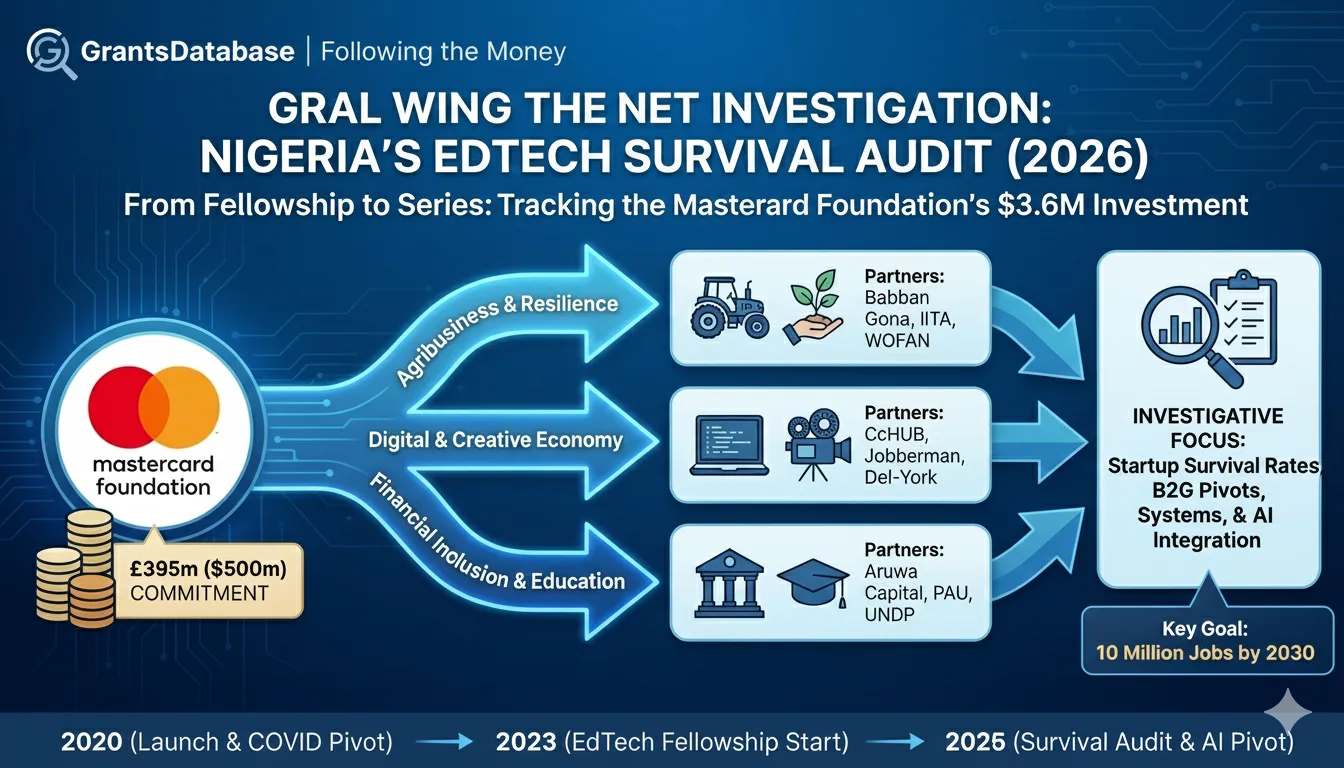
This special edition of Following The Money provides a comprehensive forensic audit of one of the most significant capital injections into African human capital: the Mastercard Foundation EdTech Fellowship, implemented in a high-stakes partnership with the Co-creation HUB (CcHUB). Since its launch in 2023, this $3.6 million (£2.84 million) fellowship has functioned as a strategic lifeboat for 36 Nigerian startups, providing each with $100,000 in equity-free capital.
However, our investigation reveals that this is merely a “seed” within a much larger $500 million+ Young Africa Works Nigeria strategy. As we enter January 2026, we examine the survival velocity of these ventures against a backdrop of severe currency devaluation, a “funding winter,” and a pivot toward Generative AI. This report tracks the journey from “Fellow” to “Series A contender,” interrogating whether these grants have built sustainable businesses or merely temporary shelters from an unforgiving economic reality.
1. The Macro Ledger: Beyond the $3.6M
While the EdTech Fellowship is the most visible “tech” play, it sits atop a massive financial pyramid. To understand the survival of these 36 startups, one must look at the broader Mastercard Foundation Young Africa Works strategy, which aims to enable 10 million young Nigerians to access dignified work by 2030 (Mastercard Foundation Nigeria Strategy).
- Total Committed Capital: Over $500 million has been deployed across Nigeria since 2020 through various channels.
- The Ag-Tech Nexus: Partners like Babban Gona have received massive tranches to empower over 585,000 smallholder farmers, creating a “rural middle class” that EdTechs eventually hope to serve (Babban Gona Impact).
- The VC Catalyst: The Mastercard Foundation Africa Growth Fund (MFAGF) acts as a “Fund of Funds,” investing in managers like Aruwa Capital Management, which recently raised 90% of its $40 million Fund II in April 2025 (Aruwa Capital Fund II Close).
2. Forensic Audit: The Three-Year Evolution (2023–2025)
The fellowship was not a static program; it evolved alongside Nigeria’s deteriorating macroeconomic indicators.
| Year | Cohort Focus | Macro Context | Key Outcome |
| 2023 | K-12 & Content | ₦460/$1 Exchange Rate | Market Entry: 12 startups focused on digitising curriculum. |
| 2024 | Resilience & Skills | 1,500+/$1 Exchange Rate | Survival Pivot: Shift from B2C (Parents) to B2B (Schools). |
| 2025 | AI & Inclusivity | 30%+ Inflation | Efficiency Gain: Leveraging LLMs to lower operating costs. |
3. The Startup Dossiers: Survival Deep-Dives
The Infrastructure Leader: EduTAMS
Led by Dr Ademola Adenubi, EduTAMS is the fellowship’s “Gold Standard” for Business-to-Government (B2G) integration.
- The 2026 Status: They are the primary engine for the Ogun State Education Revitalisation Agenda, digitising over 2,000 schools.
- Data Point: By early 2026, they have onboarded 7,000 lesson contents and processed assessments for over 500,000 students (EduTAMS Testimonial).
The IP Powerhouse: Kunda Kids
Kunda Kids proved that African educational content is a viable global export.
- Funding Milestone: Leveraged their $100k fellowship grant into a $700,000 pre-seed round led by Zrosk Investment Management (Tekedia Funding News).
- Global Reach: In 2025, co-founder Louisa Olafuyi was named a Top 20 African Business Hero, and their animation series Kunda & Friends was picked up for in-flight entertainment by Brussels Airlines (Kunda Kids News).
The AI Native: AI Teacha (Cohort 3)
As part of the December 2025 “Demo Day,” AI Teacha demonstrated the future of “Lean EdTech.”
- Efficiency Metric: They have already engaged 7,000 educators, using AI to reduce lesson preparation time by 40% (CcHUB Cohort 3 Report).
4. The “Invisible” Infrastructure: Scholarship & Alumni Wealth
Our investigation identifies a critical but often ignored asset: the Mastercard Foundation Scholars Program.
- The Brain Gain: Thousands of Nigerians have received fully-funded master’s degrees from institutions like McGill, Cambridge, and ASU (McGill Alumni List).
- The Alumni Network: In late 2025, CcHUB launched an official EdTech Alumni Network. This “hidden” network of thousands of highly educated Nigerians returning from the diaspora is becoming the primary talent pool for the 36 fellowship startups.
5. The Gatekeepers: Who Actually Holds the Keys?
To follow the money, one must look at the Implementing Partners. The Mastercard Foundation rarely moves funds directly; it uses “Gatekeepers” to ensure compliance and impact.
- CcHUB (Digital/EdTech): Manages the $3.6M EdTech Fellowship.
- UNDP (Innovation): Implementing the Young Africa Innovates program, which selected 210 innovators in September 2025 for “Stage Gating” (UNDP Nigeria Announcement).
- KPMG/Aruwa Capital (Financial): Manages the flow of growth equity to mid-sized firms (Aruwa Capital Digest).
6. Macroeconomic Forensics: The Devaluation Gap
The $100,000 grant given in 2023 is not the same as the $100,000 given in 2025.
- 2023 Cohort: Received ~₦46 million. This was enough to hire a senior engineering team of 5 for two years.
- 2025 Cohort: Received ~₦150 million. While the Naira amount is higher, the “Imported Tech Debt” (AWS, Google Workspace, Zoom) is 3x more expensive.
- Result: Startups that did not raise external USD-denominated capital by early 2025 are facing a “Runway Cliff” in Q1 2026.
7. The Investigative Verdict: Survival vs. Scale
The Mastercard Foundation/CcHUB partnership has successfully “de-risked” 36 startups that would have otherwise perished in the 2024 economic downturn. However, the audit shows that less than 20% have secured the “Series A” funding ($5M+) required to reach Nigeria’s 18 million out-of-school children.
The Final Question: As the 2026 cohort of the Fellowship prepares to launch with a renewed focus on AI and government integration, will the legacy of the original 36 be seen as a one-time humanitarian bailout for a struggling tech sector, or have they successfully built the permanent digital rails upon which the future of Nigerian education will run?
